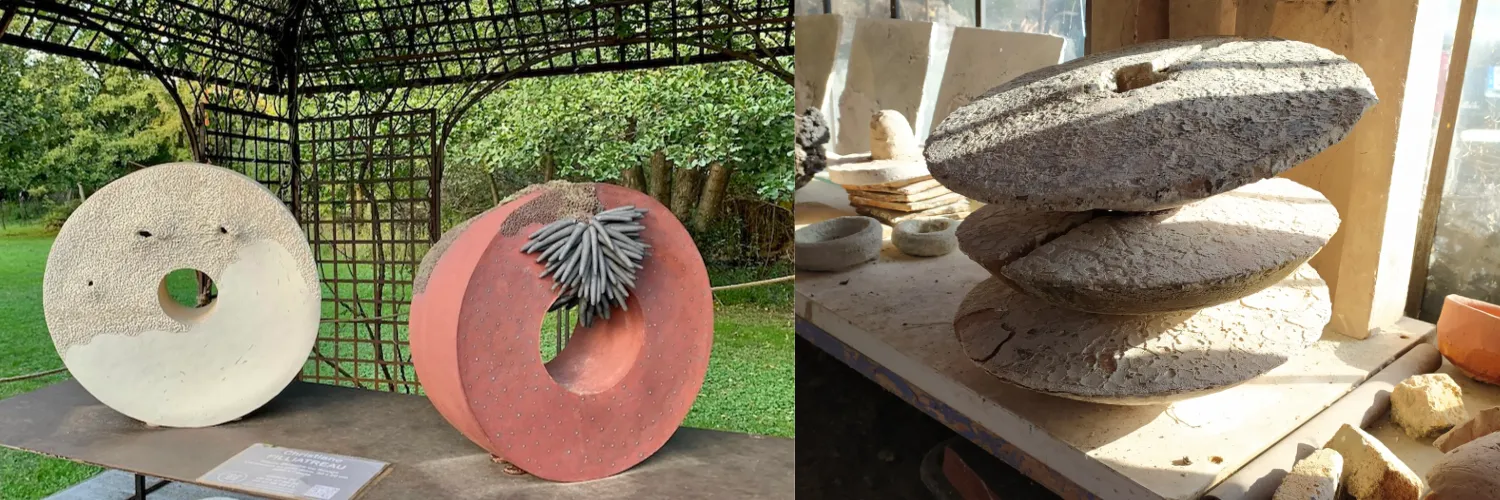
Think you know ceramics? Take a closer look. Between Camille Virot’s controlled brutality and Christiane Filliatreau’s organic sensuality, there is a world of difference, a seismic fault line. These two artists, pillars of the current scene, do not manipulate clay in the same way. One seeks rupture through the mixing of materials, the other fusion through the slow movement of the hand. It is this confrontation of styles, this tension between the raw and the fluid, that the artmourier.com platform highlights. To understand their work is to grasp that contemporary ceramics are not decoration, but a physical presence, sometimes disturbing, always alive.
Marked by her childhood in Morocco, Christiane Filliatreau has a visceral and direct relationship with the earth. She rejects the mechanics of the potter’s wheel in favour of hand modelling, patiently assembling balls and coils.
His sculptures display fluid organic forms, silent echoes of the wild nature of the Luberon. The artist strips everything down to radical monochrome.
Camille Virot does not simply turn containers, he forges the bowl as the total ceramic object, an almost architectural obsession. His use of raku serves as the basis for a visceral artistic expression, far removed from rigid traditions.
He breaks technical boundaries by merging clay with concrete or broken glass. This hybrid material physically embodies his environmental commitment.
One might think that everything has been said about terracotta, but that would be a grave mistake. Look at how these two major figures, featured on Art Mourier, fragment reality. Here is the raw data that separates their worlds.Critères
Camille Virot disrupts traditional raku firing by injecting concrete and glass fragments into the process. Christiane Filliatreau, on the other hand, prefers the tranquillity of pure modelling, building up the clay with coils. It is a direct clash of methods.
Yet a shared obsession with untamed nature runs through their respective works. They push the boundaries of contemporary ceramics far beyond the utilitarian. It is a necessary visual break.
You have grasped the essence of their work. But let’s be pragmatic: finding authentic, certified and available pieces is often an uphill battle. Most enthusiasts miss out on gems simply because they don’t know where to look, risking acquiring works with no guarantee of provenance. To avoid this pitfall, it is necessary to turn to established players.
Far from anonymous marketplaces, artmourier.com stands out as a discerning online gallery dedicated to contemporary art. With over 20 years of passion behind it, this organisation guarantees the absolute authenticity of the works and secures each acquisition for the collector.
The platform showcases a carefully curated selection of works by Camille Virot and Christiane Filliatreau, offering a direct and reliable gateway to their unique world.
What makes contemporary production so radical is its ability to break free from traditional codes and become a medium of total artistic expression:
Breaking away from purely utilitarian objects.
Constant dialogue with the visual arts and design.
The importance of the artist’s gesture and conceptual approach.
Exploration of various techniques (raku, modelling, mixed media).
These markers precisely define what makes today’s ceramics so unique and intellectually stimulating.
Between Camille Virot’s rugged raku and Christiane Filliatreau’s organic curves, ceramics become a silent language where the material vibrates with a new intensity. These works, available on Art Mourier, are not mere objects, but fragments of the imagination that invite us to touch the very essence of contemporary creation. Discover ceramics