Svetà Marlier, contemporary figurative painter: reality on the edge of a dream
Trained in Moscow and now based in Nice, Svetà Marlier paints figures who seem to look straight at us, drawing on a blend of reinterpreted masterpieces, dreamy childhood memories and crowds in black and white. Charcoal, acrylic and oil: a figurative body of work that is both classical and highly contemporary, always focused on light.
A childhood spent in the workshop
Svetà Marlier was born in 1975 in Moscow into a family of artists. Her grandfather and her uncle, the Ukrainian painter Yuri Tchary, shaped her artistic vision from a very early age. At the age of eight, she enrolled at the Moscow School of Art, where she continued her studies until graduation, honing her skills in both drawing and painting. A Franco-Russian artist, she now lives and works in Nice, where she is an active figure on the art scene and is often spotted cycling through the city’s streets.
Dreamlike quality and realism
Her style oscillates between dream and reality. First, there is the drawing: she strips it down to the bare essentials, retaining only the essence of the line. Then there is her highly personal approach to presenting the subject, which adds an element of mystery and transforms the sensory experience into an almost metaphysical exploration. Her Russian heritage and her embrace of French culture inform this contemporary figurative painting.
Black stone and acrylic: a thousand shades of grey
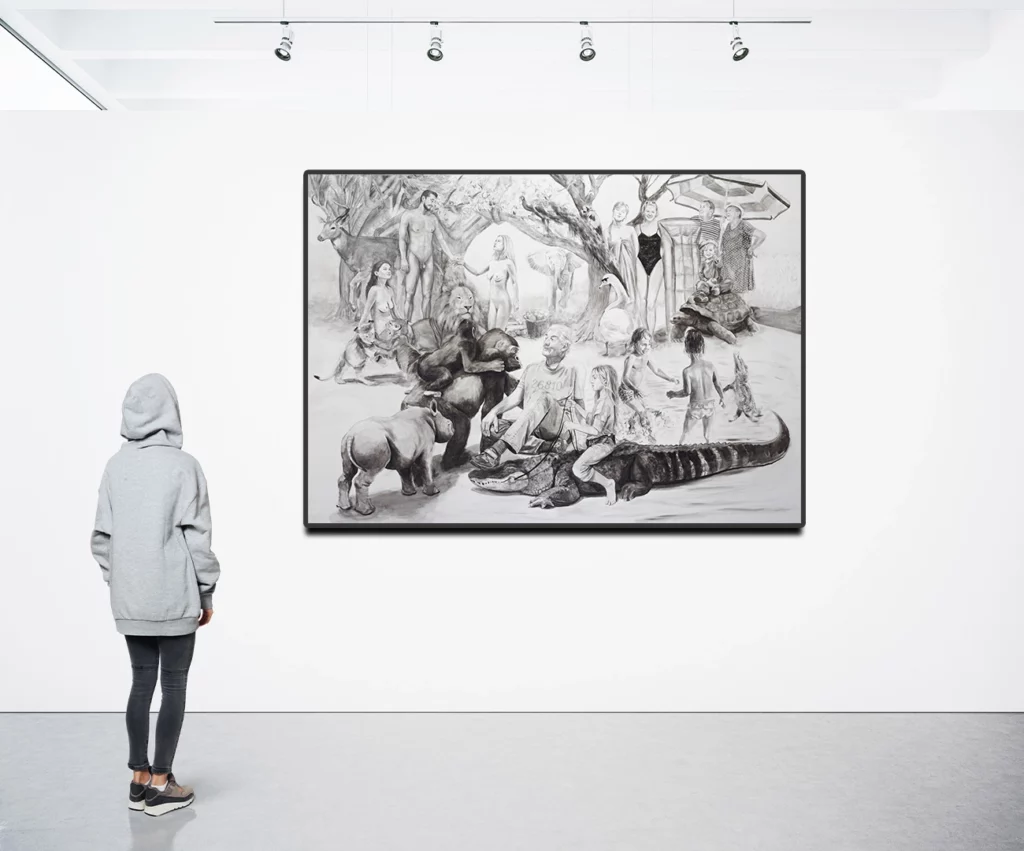
Svetà Marlier does not confine herself to any one technique: she combines oil, acrylic, graphite and black chalk, depending on what each painting requires. For her large-scale compositions, she works primarily with black chalk, with its very pronounced matt finish, enhanced by touches of acrylic. These touches create an infinite variety of greys and make the light shimmer. This approach distances her figures from mere anecdote and avoids the pitfall of photorealism: they remain both familiar and idealised, and gradually take on the quality of allegories.
Personalised figurative art: the studio open to artists
Svetà Marlier enjoys painting the people around her. In her series known as ‘personalised figuration’, artists and friends from the Nice art scene pose for her and feature in her large-scale compositions. It brings to mind Courbet’s Atelier du peintre, which opened its doors to his contemporaries. In 2020, she presented an exhibition in her studio entitled La Vie, featuring a large canvas of the same name, painted in black chalk and acrylic, measuring 220 x 150 cm. In it, she brings together children, animals and figures, with a few symbolic details scattered here and there, such as an apple or animals embodying a primal innocence. The result is a radiant portrayal of humanity, just before the fall.
The circus: a family legacy
The circus holds a special place in his creative inspiration, linked to his family history: his grandfather used to play truant to go to the circus, and his brother later ran his own circus in Ukraine. Created for the Nice Artists’ Mass in 2018, Cirque brings together several artists around the chaplain to Nice’s artists, Yves-Marie Lequin, who plays the role of ringmaster. Amongst the performers are the sculptor Patrick Schumacher and his chimera, the Rhinozébros; the artist Ulis dressed as a clown; and Svetà herself, on her horse. Through this gathering of personalities in the ring, she demonstrates that everyone can express themselves through art, in all its forms.
The Exodus: a message of hope
The Exodus of Artists, the Exodus version of which dates from 2017, is a black stone and acrylic work measuring 220 x 150 cm. It depicts the universal and timeless exodus of humanity, which belongs to no country nor any particular group of people. The message is deeply personal: we recognise artists whom Svetà admires, such as Nivèse Oscari, the only female artist of the École de Nice, and her husband Frédéric Altmann, a photographer and critic of the École de Nice. In the foreground, we see the artist’s own daughter, standing next to her abandoned teddy bear. Yet Svetà Marlier’s work is never pessimistic: she weaves into it a message of hope – that of a people on the move, emerging from the gloom towards the light, with children at the forefront.
Figures that look at us
Her oil paintings depict intense figures, often set against dark or richly coloured backgrounds, and several of the canvases are signed and dated ‘Svetà ‘24’.
We encounter children and teenage girls lost in their own inner worlds. In The Reader, a little girl sits sulking in a cross-legged position in front of a tablet, her teddy bear beside her, sweets at her feet. In Cartomagie, a little girl in a lace dress stands amidst a flurry of playing cards, next to a white rabbit, as if in Wonderland. Agacée depicts a teenage girl leaning on her elbow next to a can of fizzy drink, with a very contemporary feel. Clown depicts a child with a red nose and a blue hat, set against a deep black background.
Other figures are more theatrical. The Animal Sorceress wears a top hat, with two small animals on her shoulders, set against a baroque gold and grey backdrop. The Archer, her eyes rimmed in black, holds her arrows as if they were the bars of a cage. With Water Magic II, everything in the tale is turned on its head: a young girl in a red scarf is carrying a pig, whilst two others, with wings, fly through a cloudy sky above a pond.
A dialogue with art history
Svetà Marlier enjoys reinterpreting iconic images. The Last Judgement places a young, masked boy in front of the tormented figures in a fresco depicting the Last Judgement. Superman rides a rearing white horse, his red cape billowing in the wind, in the tradition of the heroic equestrian portrait. Even Echevelé, an old man wearing a mask with wild, dishevelled hair, has the presence of a masterful portrait.
Other large-format black-and-white prints
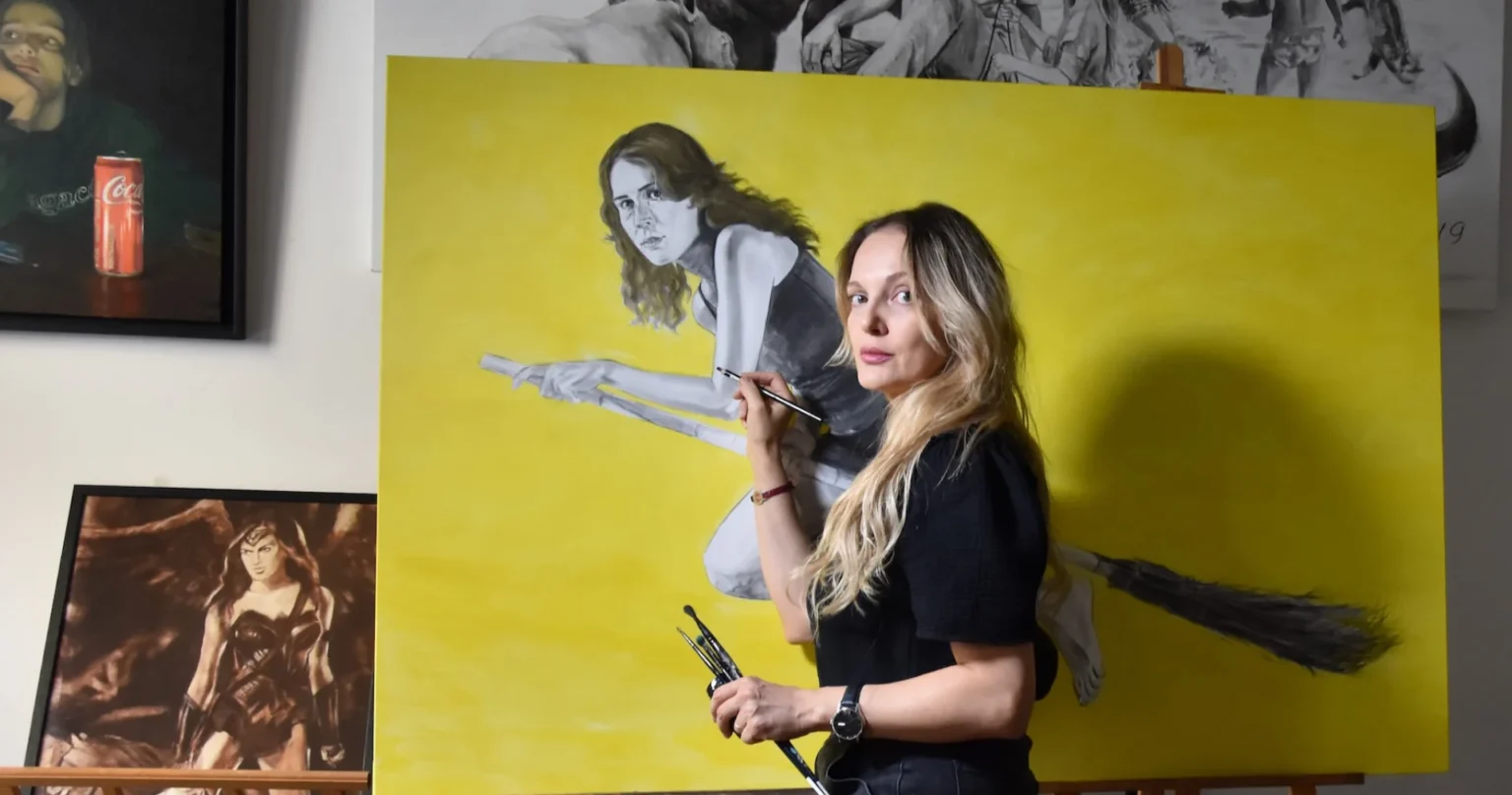
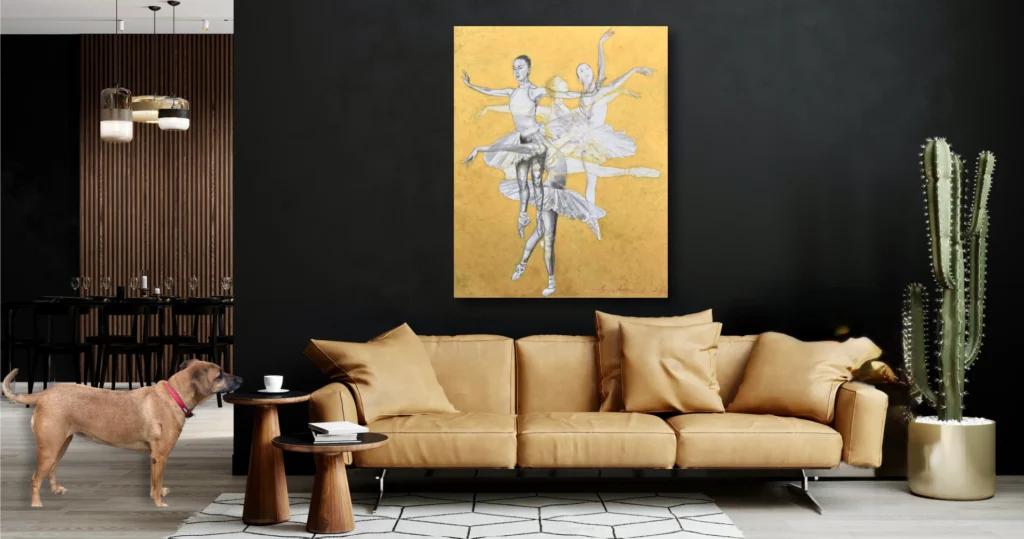
Lunch on the Raft brings together dozens of characters on planks buffeted by the waves. Apocalypse isolates a child and his rocking horse in a beam of light, whilst Dante’s Divine Comedy depicts silhouettes falling into a dark forest. Other works play with colour: Le cri multiplies the image of a young girl with outstretched arms against a yellow background, Odette depicts ballerinas dancing against a gold background, and Spider-Man superimposes silhouettes in red and blue lines.
Original paintings and digigraphs
The original paintings, each one unique, are priced from €2,000. To bring this world into your home at a more affordable price, the gallery offers digigraphs of Cartomagie II, Lanceuse de flèches, The Reader II, Magician with Animals II and Magic of Water I. Each print is limited to 10 copies, printed on canvas in 80 x 80 cm format, priced at €650. This high-definition art print captures the nuances of the original work and allows you to start a collection without compromising on quality.
Why I’m exhibiting it
I wanted to exhibit Svetà Marlier first and foremost for her creativity. She moves from oil to acrylic, from graphite to black chalk, and each technique seems to serve her in inventing a new image. I also chose her because she is a superb draughtswoman: her line is confident and refined, and she maintains this quality even in her most exuberant paintings. Finally, there is her energy and zest for life, which are palpable both in the studio and in her paintings. She is a true talent, and I am delighted to introduce her to collectors.