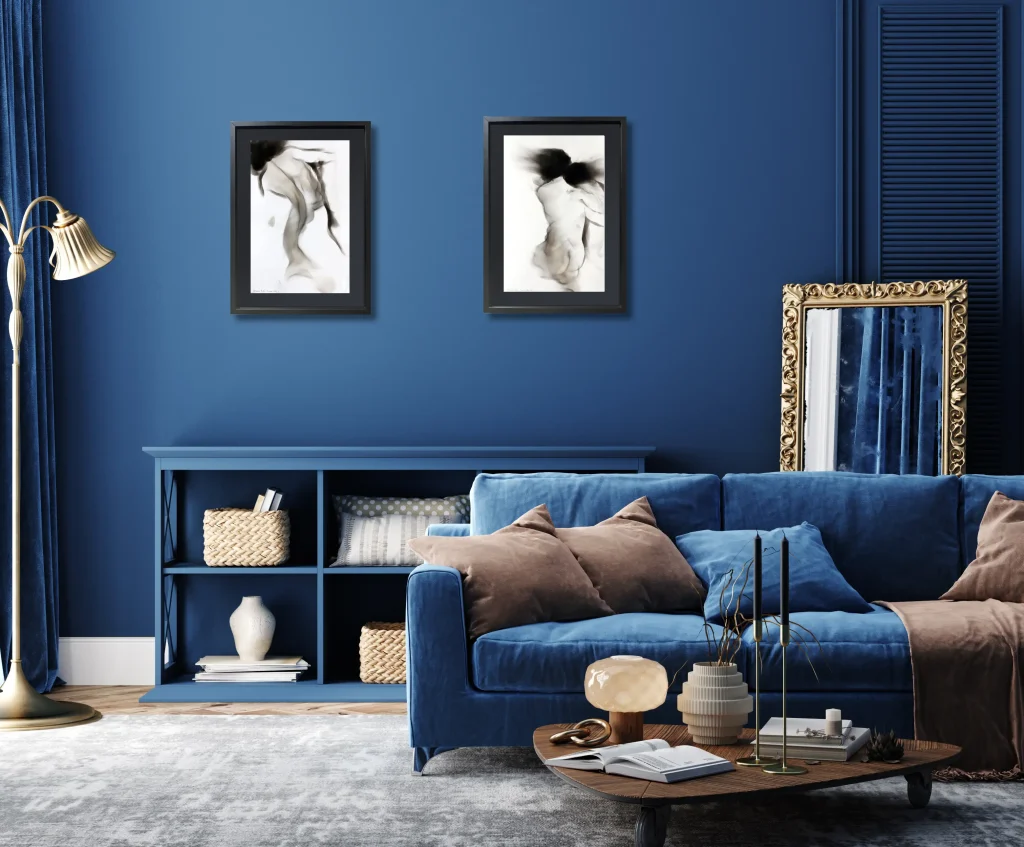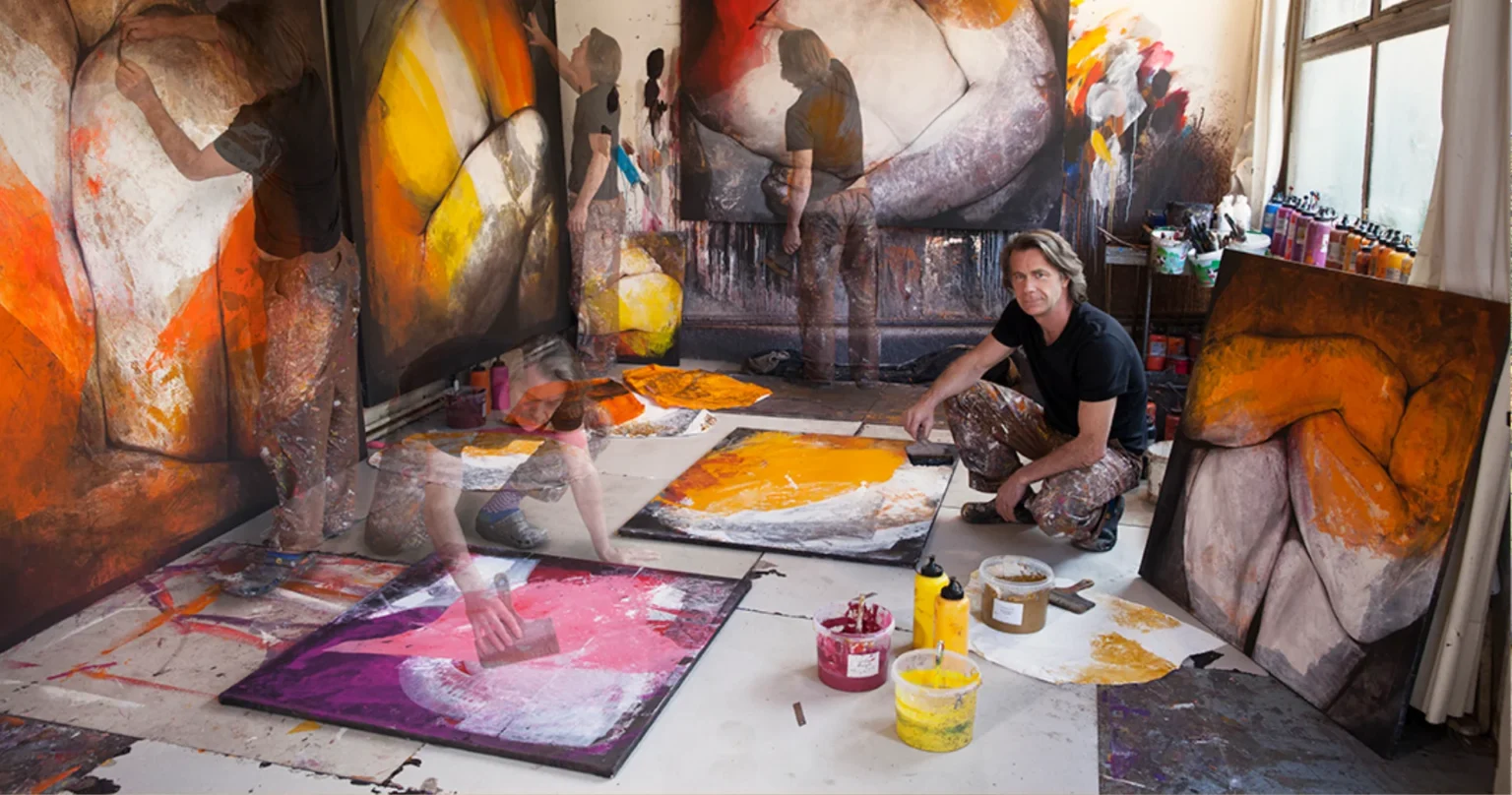
In Étienne Gros’s work, the gaze never strays. It slips into the hollow of a back, lingers on a knee, follows the curve of a bent arm. The tight framing transforms the human body into an intimate landscape, made up of contours, folds and light.
Born on 20 March 1962 in Saint-Dié-des-Vosges, this French painter devotes his work to exploring the body in all its complexity and beauty. He does not describe it: he brings it to life.
Étienne Gros studied at the Épinal School of Fine Arts, then at the Versailles School of Fine Arts, and graduated from the Paris School of Fine Arts, where he remained from 1981 to 1986. There, he attended the studios of Iscan, Olivier Debré and Vladimir Veličković, painters who encouraged him to adopt a free style and a vibrant use of material.
The poet and art critic Alain Bosquet has written an essay on Étienne Gros entitled Les anatomies brisées. In it, he describes intense and sombre paintings, which make the most of freedom of movement and a colour scheme that is at times rigorous, at times left to chance, yet whose subject matter remains precise, almost obsessive.
In his view, the line is bold and reduced to a few essential strokes. The forms draw closer as if to push further apart, and the bodies struggle with one another or against themselves. Bellies, hips, knees and ankles always appear fragmentary, without faces or any sign of pain. Alain Bosquet sees in this a disembodiment that transcends horror: flesh becomes bone, then stone. He concludes that there is in Étienne Gros ‘strength and restraint’, and that this painter is one to watch.
This sombre and powerful gaze lends depth to a work that is never content with mere formal beauty.
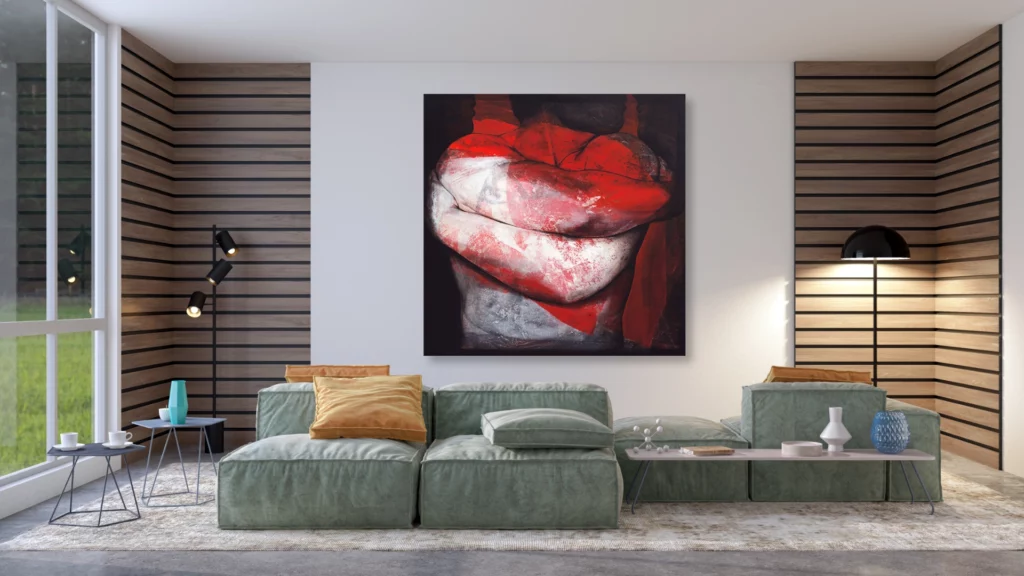
His contemporary paintings first take shape on paper: the pigments are applied there, then transferred onto canvas. This technique gives the surfaces an almost mineral-like texture, where the colour blends with the textures of the skin.
One thinks of the deep red of the Le bras rouge or of Genou blanc, which envelop pale flesh. The blue of Dos en bleu makes a bust emerge from the canvas, and the Halo Orange flares up around a shoulder. The figures seem to emerge from the canvas to meet the viewer’s gaze.
Étienne Gros also practises a unique technique, flame drawing. Using the smoke from a candle or a paraffin lamp, he creates shapes on the paper: no sharp outlines, just grey and black veils, silhouettes that seem to appear and vanish.
The works in the Fumée series, such as Fumée 24b35 or Fumée 19c29, seem alive and ephemeral. They capture moments of grace that chance has fixed upon the page.
Étienne Gros’s work is influenced by his perspective as a sculptor. He seeks to lend a three-dimensional quality to his paintings, in which abstraction meets figuration. This tension gives rise to a sense of volume and movement.
Since 1990, Étienne Gros has exhibited regularly in France and abroad: in Paris, Lille, Nantes and Annecy, as well as in Chicago, Munich and Brussels. In 2006, he was awarded the Grand Prix Azart at the Mac art fair. He now lives and works in the Paris region.
At the Galerie Art Mourier, we are exhibiting original works by Étienne Gros – paintings on canvas and flame-drawn works – for lovers ofcontemporary art as well as collectors.